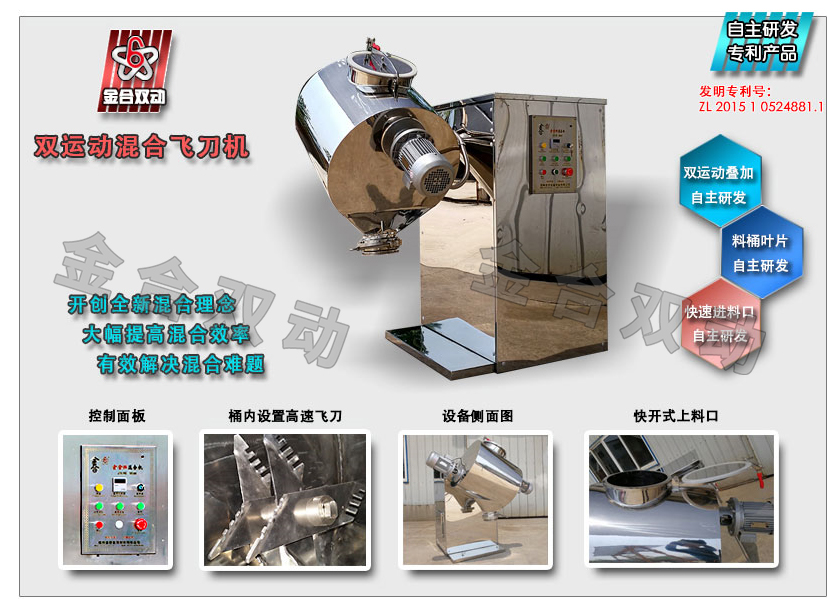
JHF600 auto high speed dual motion chopper mixer machine in PTFE industry
Company
Equipment
Polytetrafluoroethylene (PTFE), boasting exceptional resistance to high and low temperatures, excellent chemical inertness, superior electrical insulation, and good biocompatibility, has become an indispensable key material in cutting-edge fields such as aerospace, high-end electronic communication, medical devices, and national defense. To meet the stringent performance requirements of specific application scenarios (e.g., enhanced thermal conductivity, electrical conductivity, wear resistance, or colorability), PTFE base materials often require precise addition of trace elements like copper powder, carbon fiber, carbon black, and molybdenum disulfide for composite modification. This refined compounding process imposes nearly harsh requirements on the performance of mixing equipment: high efficiency, uniformity, no dead corners, and low temperature rise.
For a long time, high-speed mixers have been widely adopted in the industry for mixing PTFE composite materials. However, their inherent technical flaws are fully exposed when handling high-demand materials like PTFE. The traditional mixing barrel is fixed, relying solely on high-speed rotating fly cutters to forcibly disperse and shear materials. This single motion mode struggles to overcome the cohesion and electrostatic force between materials, easily forming stubborn dead corners on the barrel wall and bottom, leading to uneven distribution of trace elements. To achieve strong shearing, the fly cutter motor requires substantial power, generating a large amount of heat during operation. PTFE is extremely temperature-sensitive; local overheating can directly cause material softening and agglomeration, which not only undermines the achieved mixing uniformity but also seriously impacts the performance stability and appearance of the final product. There are inevitably dead corners of several millimeters to centimeters between the fixed barrel and the high-speed rotating fly cutter blades that cannot be reached by mixing.
Faced with the insurmountable bottlenecks of traditional equipment, the dual-motion fly cutter mixing technology has emerged as the preferred solution for efficient and uniform mixing of PTFE composite materials. A leading PTFE product enterprise in Liaoning, after in-depth inspection of this technology at the Shenzhen International Rubber and Plastics Exhibition, immediately confirmed it as the key equipment to meet its stringent production needs.
The powerful dispersion of high-speed fly cutters: the high-speed rotating fly cutter assembly continuously cuts, impacts, and shears materials at high speed, quickly breaking up agglomerations and achieving initial dispersion of the base material and micro-additives. The two-dimensional motion of the mixing barrel ensures that all materials inside the barrel, especially those near the barrel wall and bottom, continuously participate in overall flow. Materials in the barrel undergo complex convection, diffusion, folding, and tumbling, realizing the perfect combination of "strong dispersion by fly cutters" and "full motion of the barrel," which completely eliminates the static dead corners existing in traditional mixers. Materials are forcibly moved away from any potential low-flow areas during motion, ensuring no blind spots in the entire mixing chamber.
For manufacturers pursuing high-performance PTFE composite materials, mixing uniformity is the cornerstone determining the performance reliability of final products. Restricted by their static structure and strong thermal effect, traditional high speed mixers have become a bottleneck limiting product quality improvement and production efficiency. With its innovative kinematic design, the dual motion fly cutter mixer achieves a mixing process characterized by high efficiency, uniformity, no dead corners, and low temperature rise, perfectly matching the precise requirements for composite modification of high-demand materials like PTFE. This technology not only provides an ideal solution for the Liaoning customer but also represents a clear direction for the upgrading of mixing processes in the fluoroplastic industry, laying a more reliable foundation for material preparation in high-end application fields such as aerospace, electronic and electrical engineering, and medical and health care.
Would you like me to compile a
glossary of core technical terms in this English translation (including material names, equipment components, and performance indicators) to facilitate your technical communication and document use?









 DIASRIOUTION NETWORK